For medical and healthcare brands, choosing between OEM and ODM rehabilitation equipment is an important decision. The right manufacturing model can affect product development cost, launch speed, customization level, and long-term product differentiation.
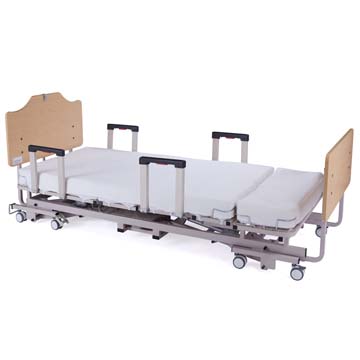
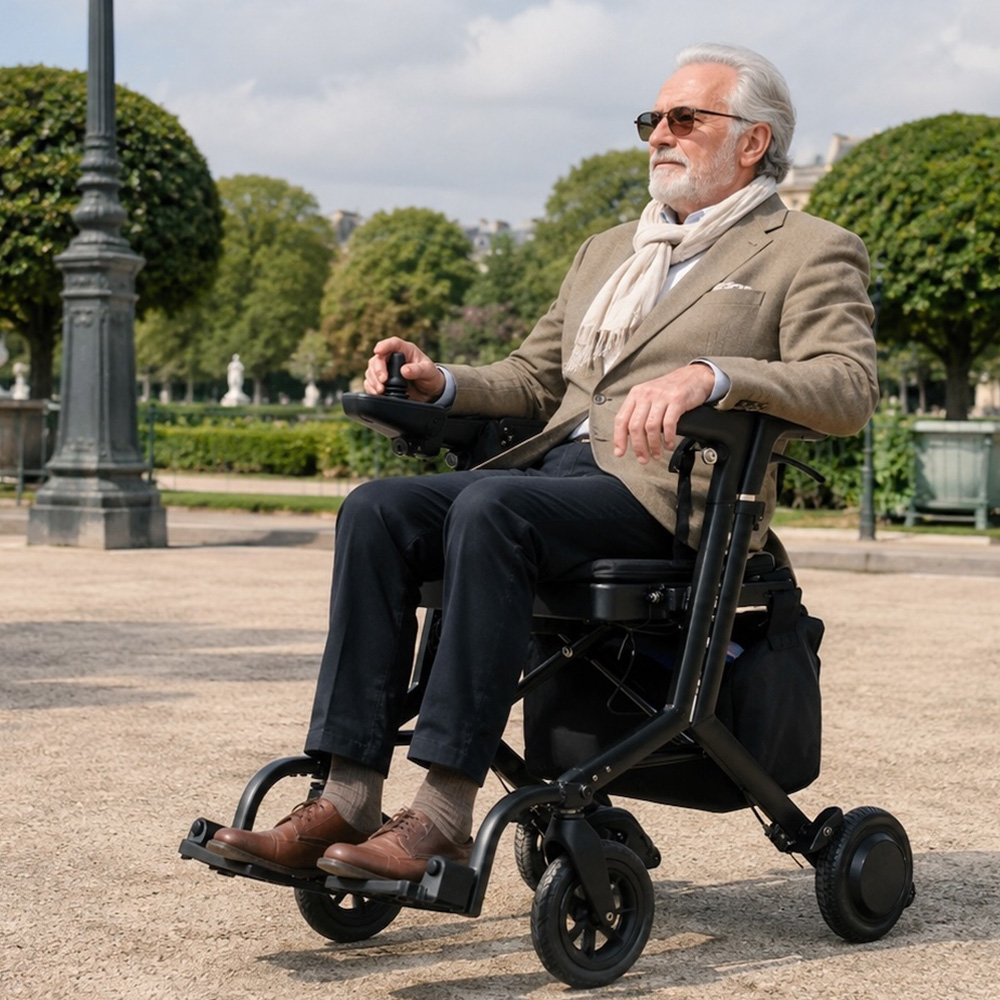
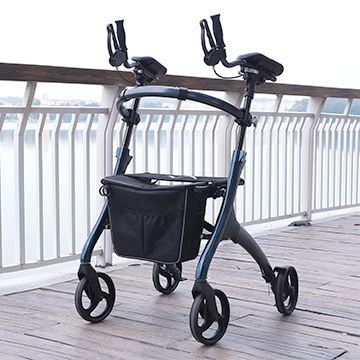
OEM and ODM are both common in rehabilitation equipment manufacturing, but they serve different business needs. Understanding the difference can help brands choose a more efficient path for products such as rollators, walkers, shower chairs, commode chairs, patient lifts, and other mobility aids.
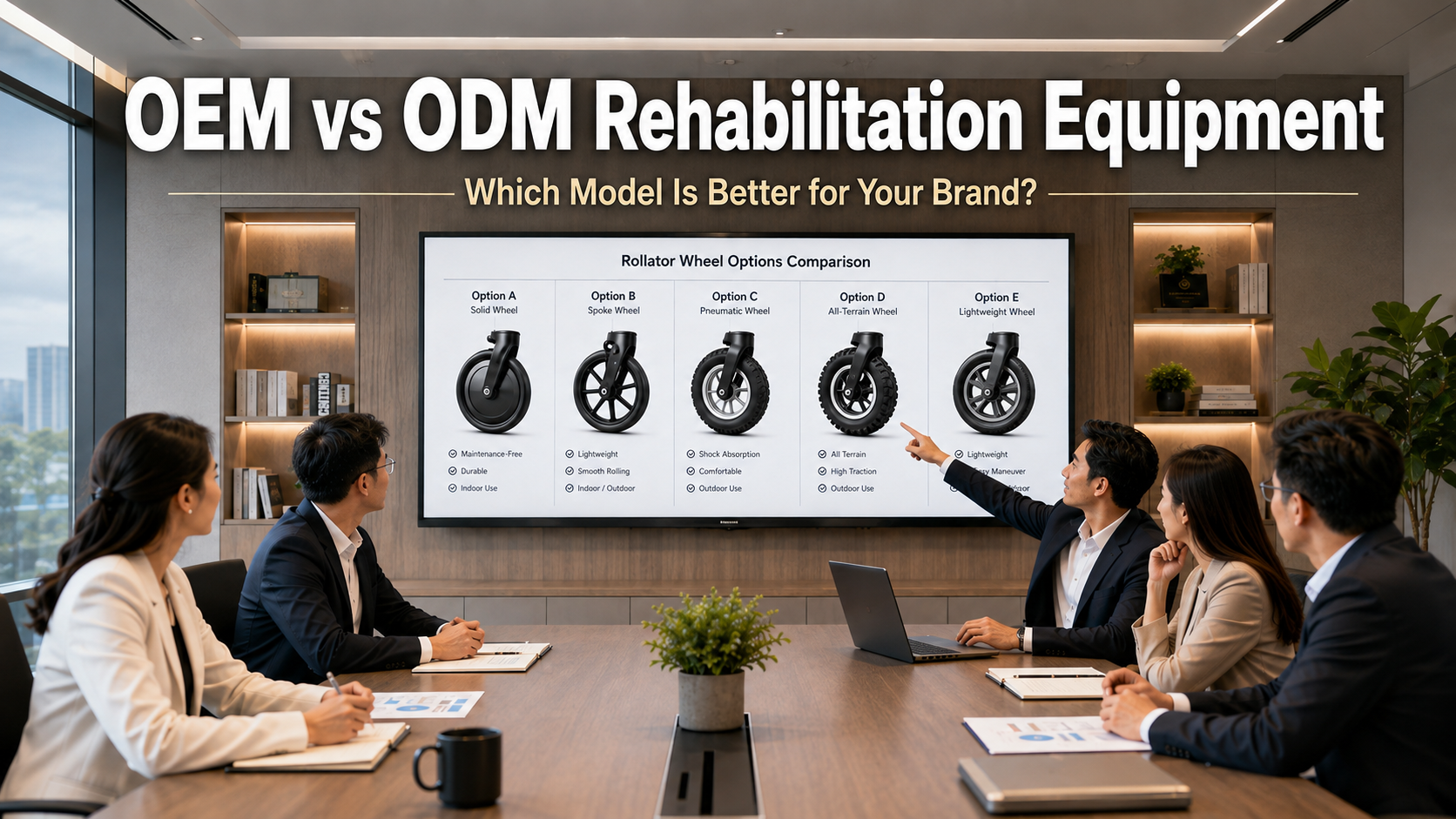
What Is OEM Rehabilitation Equipment?
OEM, or Original Equipment Manufacturing, usually means producing a product under the customer’s brand based on an existing or relatively mature product platform.
For rehabilitation equipment, OEM customization may include:
Brand logo and private labeling
Frame color and surface treatment
Packaging and instruction manuals
Product configuration
Accessories and selected components
Market-specific labeling requirements
OEM is often suitable for brands that want to enter a market faster without developing a completely new product.
Because the basic product structure has already been developed and tested, OEM projects usually require less development time and lower upfront investment than full ODM development.
What Is ODM Rehabilitation Equipment?
ODM, or Original Design Manufacturing, involves deeper product development.
In an ODM project, the manufacturer may support the brand from product concept to mass production. This can include industrial design, structural engineering, material selection, prototyping, testing, tooling, sample verification, and production transfer.
ODM is more suitable when a brand wants to:
Develop a new rehabilitation product
Solve a specific user pain point
Create a unique product structure or function
Build stronger differentiation from competitors
Develop an exclusive product line
For example, a brand may want a compact indoor rollator, a shower chair with a different seating structure, or a patient lift designed for a specific care environment. These projects usually require more engineering and testing than simple OEM customization.
OEM vs ODM: What Is the Main Difference?
The main difference between OEM and ODM rehabilitation equipment is the level of product development.
| OEM | ODM |
| Based mainly on existing products | Based on new or significantly modified products |
| Faster development | Longer development process |
| Lower initial investment | Higher development investment |
| Limited structural customization | Greater design flexibility |
| Suitable for faster market entry | Suitable for product differentiation |
Neither model is automatically better. The right choice depends on the brand’s product strategy.
When Should Your Brand Choose OEM?
OEM may be the better option when:
You already know what type of product you need
Speed to market is important
Your budget for product development is limited
Branding and configuration changes are enough
You want to test market demand before investing in a new design
For many brands, OEM is an efficient way to expand a product portfolio with lower development risk.
When Should Your Brand Choose ODM?
ODM may be more suitable when:
Existing products cannot meet your requirements
Your target users have specific unmet needs
Product differentiation is important
You want greater control over structure, appearance, or function
You are building a long-term proprietary product line
ODM usually requires more communication, prototyping, testing, and investment, but it can create stronger long-term market differentiation.
Can Brands Combine OEM and ODM?
Yes. OEM and ODM do not have to be completely separate strategies.
A brand may begin with OEM rehabilitation equipment to enter the market quickly, collect customer feedback, and understand demand. Later, the brand can use that market knowledge to develop exclusive ODM products.
This combined approach can balance development cost, speed, and innovation risk.
How Genteel Supports OEM and ODM Rehabilitation Equipment
Genteel supports healthcare and mobility aid brands with OEM and ODM manufacturing solutions for rollators, walkers, shower chairs, commode chairs, patient lifts, and other rehabilitation related products.
For OEM projects, Genteel can support launch kit (including product videos, product pictures and so on), color, packaging, labeling, and production customization.
For ODM projects, Genteel can support product development, structural design, prototype development, testing, sample verification, production engineering, and quality control.
The goal is not simply to choose OEM or ODM, but to select the manufacturing model that best matches the brand’s market strategy, budget, development timeline, and product requirements.
Conclusion
OEM rehabilitation equipment is generally better for brands that need faster market entry, lower development investment, and customization based on existing products.
ODM rehabilitation equipment is better suited to brands that want deeper product development, stronger differentiation, and more exclusive product solutions.
For many healthcare and rehabilitation device brands, the best strategy is to use OEM for efficiency and ODM for long-term innovation.
FAQ
What is OEM rehabilitation equipment?
OEM rehabilitation equipment is manufactured under a customer’s brand, usually based on an existing product platform with customized branding, packaging, configuration, or selected specifications.
What is ODM rehabilitation equipment?
ODM rehabilitation equipment involves developing a new or significantly customized product from concept through design, prototyping, testing, and mass production.
Is OEM cheaper than ODM?
OEM usually requires lower upfront development investment because it is based on existing product platforms. ODM generally requires more engineering, prototyping, testing, and tooling.
Which is better for a new rehabilitation equipment brand?
OEM is often suitable for brands that want faster market entry and lower development risk. ODM becomes more valuable when the brand needs stronger product differentiation or has specific user requirements.
Does Genteel provide both OEM and ODM services?
Yes. Genteel provides OEM and ODM manufacturing solutions for rehabilitation and mobility aid products, supporting brands from customization and sample development to production and quality control.