Tube Thickness in Rehabilitation Equipment: What Matters
When developing a rollator, walker, shower chair, commode chair, patient lift, or other rehabilitation equipment, tube thickness is an important engineering parameter—but it should not be considered in isolation.
Structural performance also depends on tube diameter, material grade, frame geometry, joints, load distribution, manufacturing process, and intended use. For rehabilitation equipment brands, understanding this relationship helps avoid judging product quality by a single specification.
What Does Tube Thickness Affect?
Tube thickness refers to the wall thickness of a hollow metal tube. Within the same material and geometry, changing wall thickness can affect stiffness, resistance to deformation, weight, fatigue performance, and manufacturing characteristics.
However, a thicker tube does not automatically mean a safer or better product.
For example, a lightweight rollator may use an aluminum tube with a larger cross-section, while equipment designed for higher static loads may use a different steel structure. The appropriate specification depends on how the complete frame is designed and validated.
The key engineering question is therefore not simply “How thick is the tube?” but whether the combination of material, tube geometry, and structure can achieve the required product performance.
Why Thicker Is Not Always Better
Increasing wall thickness can improve certain structural properties, but it also increases material use and product weight.
Weight is particularly important for rollators, walkers, shower chairs, and other products that users or caregivers frequently move, fold, or lift.
A lighter structure may improve portability and handling, while products designed for higher loads may require a more robust structure. The correct balance depends on the intended user and use environment.
This is also why comparing products only by tube thickness can be misleading. A 1.5 mm tube is not automatically weaker than a 2.0 mm tube in the finished product. Tube diameter, material properties, frame design, reinforcement, welding, and load path also influence structural performance.
Steel and Aluminum Require Different Designs
Steel and aluminum are both widely used in rehabilitation equipment.
Steel generally provides higher stiffness at the same geometry, while aluminum has a lower density and can help reduce product weight. As a result, the two materials often require different tube dimensions and structural designs.
Steel may be suitable where rigidity and load-bearing performance are priorities, while aluminum is often considered for products where portability and easier handling are important.
Neither material is universally better. Material selection, tube thickness, and frame design need to be evaluated together.
Why Product Testing Matters
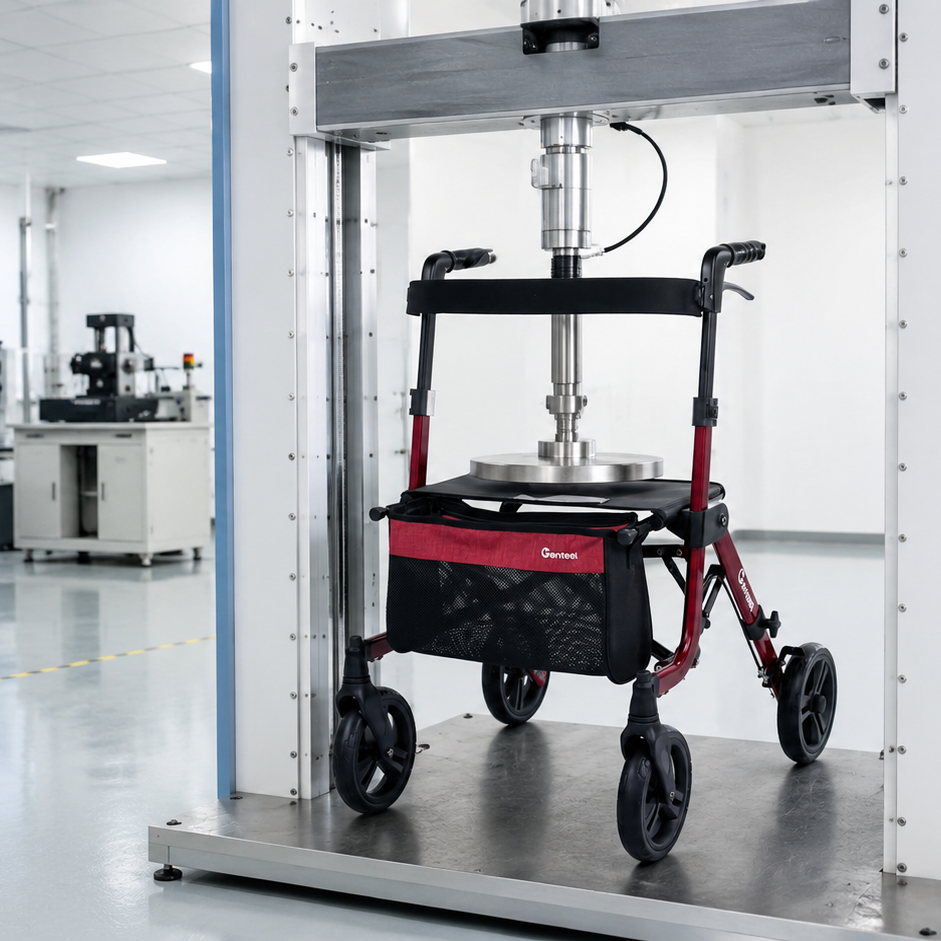
Tube specifications alone cannot confirm how a finished rehabilitation product will perform.
For example, ISO 11199-1 specifies requirements and test methods for walking frames, while ISO 11199-2 covers rollators. These standards evaluate product performance under defined test conditions rather than prescribing one universal tube thickness.
At Genteel, tube selection is considered together with product structure, intended load, usage scenario, and manufacturing feasibility. Depending on the product and applicable requirements, internal verification may include static loading, repeated-load or fatigue evaluation, stability checks, and structural inspection.
For OEM and ODM projects, early testing can help identify structural risks before tooling, mass production, or third-party testing, potentially reducing later modifications, retesting, and project delays.
Manufacturing Consistency Also Matters
Even a well-designed tube specification depends on consistent manufacturing.
Cutting, bending, welding, surface treatment, and assembly can all influence the final frame. Different materials and wall thicknesses also require appropriate process parameters.
This is why engineering, manufacturing, and quality control need to work together during product development.
Conclusion
Tube thickness is an important specification in rehabilitation equipment, but it is only one part of structural design.
For brands developing rollators, walkers, shower chairs, commode chairs, patient lifts, and other rehabilitation products, a more useful approach is to evaluate tube thickness together with material, geometry, manufacturing quality, and product testing.
At Genteel, these factors are considered together during OEM and ODM product development to balance structural performance, product weight, manufacturability, and intended use.
FAQ
Does a thicker tube always make rehabilitation equipment stronger?
Not necessarily. Tube thickness matters, but material, tube diameter, frame geometry, joints, and load distribution also affect structural performance.
Why does tube thickness matter for rollators and walkers?
These products experience repeated loading during daily use. Appropriate tube dimensions and structural design help the finished product meet its intended performance requirements.
Is steel better than aluminum?
Neither is universally better. Steel offers higher stiffness at the same geometry, while aluminum can reduce weight. The appropriate choice depends on the product design and use scenario.
Why is product testing important?
Testing evaluates the finished structure under relevant conditions and can identify risks that cannot be determined from tube thickness alone.
How does Genteel evaluate structural designs?
Depending on project requirements, Genteel combines engineering evaluation, prototype development, internal testing, production inspection, and quality control before mass production.